Nifty test

Pregnancy is a beautiful journey, and the NIFTY test is the reliable first step toward a calm and informed pregnancy.

The NIFTY test is a simple, safe, and highly accurate non-invasive prenatal test (NIPT) that can assess the risk of your baby having some of the most common chromosomal abnormalities such as Down syndrome, Edwards syndrome, Patau syndrome, and many others.


During pregnancy, a small amount of fetal DNA naturally passes into the mother’s bloodstream. This so-called fetal DNA circulates together with the mother’s blood and can be analyzed using the NIFTY test. Thanks to this, by taking only a small venous blood sample from the mother, important information about the baby’s health and possible genetic conditions can be obtained – without any intervention in the pregnancy itself.

Is NIFTY right for me?

Since genetic abnormalities can occur in any pregnancy, the NIFTY test is suitable for every woman, regardless of age or existing risk.

It may be especially beneficial for women:

  • Who want to go through pregnancy with greater peace of mind,
  • Who have a family history of genetic conditions,
  • Whose first trimester screening tests have shown an increased risk of abnormalities.

When can I take the NIFTY test?

The test can be performed starting from the 10th week of pregnancy.

Available NIFTY packages at Avicena Laboratory:

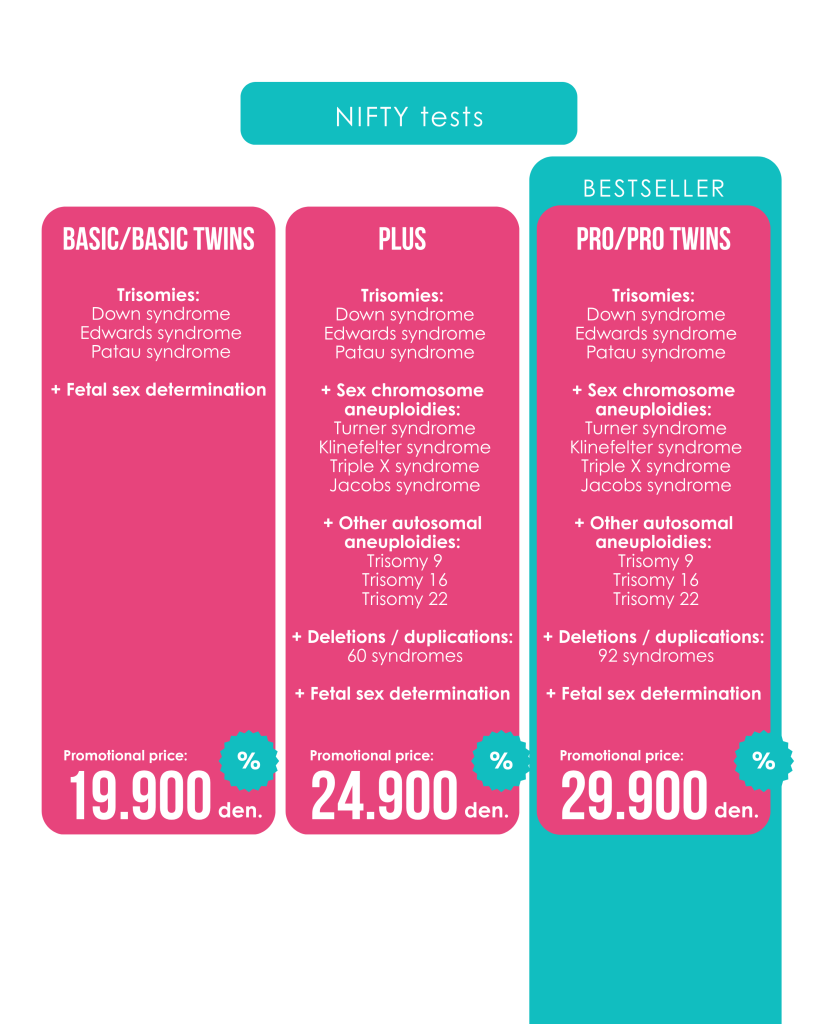
NIFTY Basic / Basic Twins

Trisomies:
Down syndrome
Edwards syndrome
Patau syndrome

  • Gender detection

Promotional price: 19,900 denars


NIFTY Plus

Trisomies:
Down syndrome
Edwards syndrome
Patau syndrome

Sex chromosome aneuploidies:
Turner syndrome
Klinefelter syndrome
Triple X syndrome
Jacobs syndrome

Other autosomal aneuploidies:
Trisomy 9
Trisomy 16
Trisomy 22

Deletions / duplications:
60 syndromes

  • Gender detection

Promotional price: 24,900 denars


NIFTY Pro / Pro Twins

Trisomies:
Down syndrome
Edwards syndrome
Patau syndrome

Sex chromosome aneuploidies:
Turner syndrome
Klinefelter syndrome
Triple X syndrome
Jacobs syndrome

Other autosomal aneuploidies:
Trisomy 9
Trisomy 16
Trisomy 22

Deletions / duplications:
92 syndromes

  • Gender detection

Promotional price: 29,900 denars


Why is the NIFTY test better than other tests?

  • It has more than 99% sensitivity and specificity for detecting the most common trisomies.
  • It offers some of the most competitive prices on the prenatal testing market.
  • It is suitable for every woman regardless of age.
  • The tests are also suitable for twin pregnancies, IVF pregnancies, pregnancies with donor eggs, as well as women with a history of recurrent miscarriages.
  • The tests are completely risk-free, unlike invasive procedures.
  • Results are available within 7 working days.

What does NIFTY testing look like in our laboratory?

If you are considering the NIFTY test, you are probably wondering what the entire process looks like. In our laboratory, we are dedicated to providing you with safety, trust, and support at every step of the testing process.

The NIFTY test is a non-invasive prenatal test that can be performed from the 10th week of pregnancy, using a simple blood sample from the mother.

💜 1. Consultation with a specialist

The process starts with a short consultation with our expert team. You will receive clear information about the possibilities, benefits, and the testing process itself, as well as answers to all your questions.

📝 2. Documentation and consent

Before the test, the necessary documentation is completed and informed consent is signed.

🩸 3. Blood sample collection

This is followed by a simple collection of a small blood sample from a vein, just like any routine laboratory analysis. The procedure is quick, safe, and comfortable.

🔬 4. Laboratory analysis

The sample is sent for analysis using the most advanced genetic sequencing technology, in order to obtain precise and reliable results.

✨ 5. Results

Results are usually ready in about 7 working days and can be received via email or collected in person at our laboratories.

🤍 With you every step of the way

Our team is here to guide you through the entire process with professionalism, discretion, and care.

📩 For more information, consultation, feel free to contact us.
💜 NIFTY tests are also available at promotional prices.

Allergy, cold or flu? We have the right answer!

Sneezing, runny nose, cough, fever…

Each of us has asked this question at least once:
“Is it just an allergy, or something more serious?”

Respiratory symptoms often look very similar, but their causes can be very different.
This is where laboratory testing plays a key role — providing reliable answers without guesswork.

Why can symptoms be misleading?

Allergies, the common cold, influenza, and other viral infections often share overlapping symptoms. Relying only on how we feel or how long symptoms last can make it difficult to reach an accurate diagnosis.

Laboratory testing is the most reliable way to identify the true cause.

How can we help you determine the exact condition?

Allergy

In our laboratory, we can determine whether your symptoms are caused by an allergic reaction through:

  • IgE testing
  • Specific allergen tests and panels (e.g. respiratory allergens: pollen, dust, etc.)

Important: Allergies are not contagious and do not require antibiotic therapy. That’s why accurate diagnosis is essential to avoid unnecessary antibiotic use and additional strain on the body.

Common cold or viral infection

With basic laboratory analyses such as:

  • Complete blood count (CBC)
  • CRP (C-reactive protein)

We can determine whether it is a mild viral infection or a condition that requires further monitoring.

Influenza (Flu A, B)

Influenza is not “just a cold.” In the laboratory, we can:

  • Confirm the presence of the influenza virus
  • Assess the severity of the infection
  • Monitor the body’s inflammatory response

Early laboratory detection allows timely and appropriate treatment, especially for high-risk groups.

Advantages of laboratory testing

  • Accurate and reliable diagnosis
  • Avoidance of unnecessary therapies
  • Fast results
  • Support for physicians in clinical decision-making
  • Greater care and confidence for patients

In our laboratory, every result means a step closer to the right solution.

When is it time for laboratory testing?

  • When symptoms last longer than expected
  • When fever is high and persistent
  • When you are unsure whether it is an allergy or an infection
  • When you want a clear and reliable answer

Conclusion

Instead of guessing, trust laboratory testing.
An accurate diagnosis is the first step toward proper treatment and faster recovery.

Our laboratory is here for you — with precise analyses, fast results, and a professional approach.

📞 For more information, contact us at 02 3179 001.

At Avicena Laboratory, we are committed to providing our patients with the most advanced, reliable, and comprehensive prenatal screenings. Our non-invasive prenatal tests NIPT VERAgene and NIPT VERACITY are among the most accurate tests for early detection of genetic conditions in babies, completely safe for both mother and fetus.

A new upgrade to enhance the prenatal experience:
From now on, both tests are expanded to include three additional microdeletions:

  • Prader-Willi syndrome
  • Angelman syndrome
  • Cri-du-chat syndrome

These microdeletions are rare but clinically significant genetic conditions, and their inclusion provides expectant parents with an even more complete insight into their baby’s genetic health.

The price and all testing conditions remain unchanged.
The testing process is simple, safe, and performed from a maternal venous blood sample, with fast and reliable results.

With this expansion, our goal is to offer even greater reassurance, peace of mind, and support for every pregnancy.

For any additional questions or information, our team is here to assist you.

How to prevent tick bites

What to do if you find a tick on you, how to recognize a tick bite and more.

As we enjoy the outdoors this summer, we should remember that we are not the only ones taking advantage of the warm weather. Warmer and longer summers mean a longer tick season. Health officials are warning of a particularly bad year for ticks, and the Centers for Disease Control and Prevention (CDC) reported earlier this year that cases of tick-borne diseases are on the rise.

The best way to avoid a tick-borne disease is to avoid being bitten by a tick.

Here’s what you need to know to protect yourself from ticks and what to do if you’re bitten.

How to protect yourself from ticks?

A key factor is to wear the right clothes.

For example, if you are walking through tall grass, in parks or forested areas, wear long pants and long-sleeved shirts, and tuck your pants into your socks so that ticks cannot touch your skin, then check your clothes and skin for ticks when you come back. When checking yourself, be sure to pay attention around your ankles or feet. If you’ve been out for a few hours or are getting checked after a few days, they could migrate anywhere, so have a friend or family member help you check your back and hairline.

What to do if you find a tick on yourself?
The tick should be removed immediately! But the entire organism must be removed. Your doctor or urgent care team can help you get this bug off your skin safely!

Avoid removing it yourself!

Never let the tick break (leave any part of its body in your skin), grab the tick by the middle, or push its contents back into your body, doctors recommend. Also, never use petroleum jelly or matches or any item mentioned in old myths to remove a tick.

How do you know you’ve been bitten by a tick?
Unfortunately, there is no way to easily distinguish a tick bite from another animal bite, such as a spider or mosquito bite. The only way you really know if you’ve been bitten by a tick is if you find the tick embedded in you while it’s biting you.

They settle down to feed on blood, and the adults stay for a day or two before fully molting, so many people find the tick before it falls off.

A tick bite is usually a red raised bump like the nasty sting of a mosquito bite. If there is a rash, you have developed an infection and go to the nearest medical facility immediately for care.

What should you do if you are bitten by a tick or suspect a tick-borne disease?
Symptoms of the tick-borne disease include fever, headaches, joint pain and rashes.

If you develop a fever, malaise or rash after being in an area where ticks are active, it is recommended that you be seen by your doctor immediately.

You can be tested for tick-borne diseases, tests detect antibodies, or the presence of tick-borne bacteria. If you find a piled up tick on your body that has obviously been there for a while, you are at greater risk for disease. You must see a doctor right away who can help prevent Lyme disease from developing.

What is Lyme disease?

Lyme disease is a multisystem disease that has a subacute and chronic course, and is caused by the bacterium Borrelia burgdorferi, which is transmitted by the tick to the host through its bite. This disease primarily affects the skin, followed by the heart, joints and central nervous system. Lyme disease is manifested by the appearance of local swelling and redness at the site of the sting and in the surrounding area, 3-32 days after the incident.

Local redness is warm and usually not painful. In 50% of patients, identical changes may occur in other parts of the body, and in 15% of patients, skin changes may not occur. In addition to skin changes, elevated temperature, fever, malaise, headache and enlargement of regional lymph nodes may also occur.

If the disease is not recognized and treated, after 6-8 weeks the second stage of the disease develops, which is characterized by neurological symptoms, joint pain and cardiac symptoms.

The third stage occurs in untreated persons who develop permanent damage to the affected organs after ten months or more.

In the microbiology laboratory at Avicenna Laboratory, its portfolio of tests includes a highly specific, indirect immunofluorescence test for the detection of IgG and IgM antibodies to Borrelia Burgdorferi sensu lato from serum (blood).
Sample required: blood
The examination should be done 1-8 weeks after a tick bite.
Price: 1500 denars

From now on, a test for molecular detection of Borrelia Burgdorferi sensu lato complex with real-time PCR through blood, which can directly prove the presence of the bacterium Borrelia burgdorferi. The results are issued in 1 day.
Sample: blood
Price: 1950 MKD

HPV (Human papillomavirus)

What is HPV?

HPV is the name of a group of viruses. There are about 40 types of HPV (Human papillomavirus) that are sexually transmitted, affecting the genitals of men and women. Some types of HPV (for example type 6, type 11, cause changes called genital warts, while other types, which are called high risk for example type 16, type 18 and others, can cause CIN changes (abnormal cell growth) which lead to the development of cervical cancer.

HOW CAN I GET INFECTED WITH HPV?

HPV is transmitted by genital contact, most often through vaginal or anal sex. Most people do not know that they have the virus or that they are transmitting it to their partner. Therefore, it is often not possible to know who transmitted the virus and when the infection occurred.

IS THERE ANY OTHER WAYS OF INFECTION WITH HPV?

There are many misconceptions about how you can get HPV. However, it is important to know that condoms do not provide 100% protection against HPV. Since the virus is also found in the skin around the genitals, the virus can very easily pass from the genital region of a man to the vagina, vulva or anus of a woman.

How does HPV cause cervical cancer?

The HPV virus causes abnormal growth of cervical cells. In most cases, HPV goes away on its own. However, when the HPV infection lasts for some time, the abnormal cells can develop into cancer (cancer of the cervix or other parts of the body).

Can I prevent cervix cancer?

Yes. There are tests that can find early signs, even before symptoms develop. In this way, the problem will be found and solved before it turns into cancer. SUCH TESTS ARE PAP TEST AND HPV TEST.

What is the difference between PAP and HPV test?

Both tests allow screening for cervical cancer. The PAP test looks for cell changes that may lead to cancer. The HPV test looks for and detects the HPV virus that causes these changes.

Can I have civics cancer if I have HPV?

Those women who have HPV are advised to follow the advice and instructions of their gynecologists for appropriate testing and treatment.

If you have HPV, your gynecologist will recommend more frequent controls and tests, all in order to find possible changes early and treat them accordingly. Therefore, follow the advice of your gynecologist.

If I have HPV can I get pregnant and have healthy child?

Having HPV does not reduce the chance of pregnancy. The type of HPV you have should not affect the health of the fetus. However, if you need treatment for abnormal cervical cells (caused by HPV), the treatment itself may affect your chances of getting pregnant. Always consult your gynecologist.

TETS FOR DETECTION OF HPV IN AVICENA LABORATORY

The correct diagnosis of HPV is of great importance and is crucial for the further treatment of the patient. At Avicenna Laboratory, state-of-the-art tests are performed with Multiplex real-time PCR technology for highly sensitive and specific molecular detection and genotyping of the HPV virus (Human papillomavirus). This test is the only qualitative and semi-quantitative clinically proven test recommended by the WHO for the detection and individual genotyping of the largest number of HPV types:

19 HIGH RISK TYPES (16, 18, 26, 31, 33, 35, 39, 45, 51, 52, 53, 56, 58, 59, 66, 68, 69, 73, 82)

9 LOW RISK TYPES (6,11, 40, 42, 43, 44, 54, 61, 70)

These HPV genotypes are responsible for over 97% of cases of cervical dysplasia and cervical cancer.

The tests have an internal control based on the detection of the human β-globin gene, which completely eliminates the possibility of false negative results. The tests are validated and CE certified, run with fully automated Real Time PCR instruments and are approved for diagnostic use.

Sample: Cervical and urethral swab.

FOR ADDITIONAL INFORMATION REGARDING THE TEST, CONSULT YOUR GYNECOLOGIST.

Urinary infections

The urinary tract represents the body’s filter for disposal of excess fluids. Due to the anatomy of the urinary tract, women are particularly susceptible to bacteria that can settle in the urinary tract and multiply – resulting in an infection of the urinary tract. Urinary infections are usually bacterial infections of the kidneys, urethra, and bladder. The most common way of spreading the infection (90%) is by penetration of bacteria through the skin around the genitals and rectum toward the bladder, which is a fertile environment for bacteria growth due to the presence of proteins, sugars and favorable temperature.

Causes:

Many different microorganisms can cause kidney and urinary tract infections, but most infections are caused by Gram-negative bacteria (Escherichia coli, Proteus, Klebsiella, Enterobacter, Pseudomonas). The bacteria Escherichia coli is detected in 80% of patients with acute infection of the urinary tract.

The other Gram-negative bacteria may cause acute urinary tract infections in patients with urinary catheters, after urological interventions, in the presence of kidney stones (calculi) and urine flow obstruction through the urinary tract.

Bacteria can reach the urinary tract from an infection elsewhere in the body through the bloodstream (hematogenous dissemination of bacteria). High-risk groups of more frequent urinary infections are patients with diabetes, pregnant women, and women in menopause due to estrogen deficiency, etc.

Symptoms:

Usually symptoms manifest in the form of frequent and painful urination, burning sensation when urinating, often followed by nighttime urination, and pain in the pelvis and back. The urine may be cloudy or with traces of blood.

Diagnosis:

The diagnosis of urinary tract infections is made by using:

– Laboratory analysis of blood and urine

– Microbiological urinalysis-urine culture with antibiogram

– Ultrasound of the urinary tract

Correct sampling of the material for microbiological analysis of urine it is of outmost importance. After proper washing of the external parts of the genital tract, a small amount of midstream (not first) urine is collected. The container in which urine is collected must be sterile. The sample (urine) must reach the laboratory for analysis in no later than two hours.

Accurate diagnosis is essential because similar symptoms may be a result of an infection of the genitals. Only your physician can make this distinction and make an accurate diagnosis.

Treatment

If a bacterial infection is confirmed, the treatment is antibiotic therapy in a way and duration as prescribed by a doctor. After completion of the prescribed therapy, a urine culture checkup should be conducted (at least one week after completion of the therapy). If it is not sterile, you should continue the antibiotic therapy, and if sterile, treatment ends. It is recommended to consume more fluids (water) and herbal teas, reduce intake of sugar and refined carbohydrates, and maintaining good personal hygiene.

What is gestational diabetes?

Gestational diabetes is a special type of diabetes that manifests itself with elevated glucose levels in the blood and occurs for the first time during pregnancy. It usually occurs in the later stages of pregnancy, often in women who have not had a history of diabetes.

Gestational diabetes most often occurs as a result of hormonal changes during pregnancy (more precisely because of hormones secreted by the placenta), which can create a predisposition for the development of insulin resistance. Insulin is a hormone of specific cells in the pancreas and enables the efficient use of glucose as fuel (energy). When the level of insulin is low, or the body can not use it effectively – due to the developed insulin resistance, the level of glucose in the blood increases.

Unlike other types of diabetes, gestational diabetes is not persistent. In most cases, gestational diabetes disappears after childbirth, but women who have gestational diabetes are at increased risk of developing it again with subsequent pregnancies and developing another type of diabetes in the future.

What are the symptoms of gestational diabetes?

Most pregnant women have no obvious or noticeable symptoms. The problem with this type of diabetes is that the pregnant woman does not notice these symptoms or associates them with another condition, so many gestational diabetics remain undiagnosed.

The most common symptoms of gestational diabetes are:

► Unusual thirst

► Frequent and excessive urination (unlike early pregnancy when urination is frequent but scarce)

► Unusual fatigue (which is sometimes difficult to distinguish from normal pregnancy fatigue)

► Elevated glucose levels in the urine detected during a routine urine test

Which women are at increased risk for developing gestational diabetes?

Тhese women are at increased risk:

– Women over 40 years;

– Have become pregnant with overweight or who have gained significant weight (more than recommended) during pregnancy;

– Suffer from high blood pressure;

– Тhey have previously given birth to a child over 4 kg;

– Manifested gestational diabetes in a previous pregnancy;

– Have diabetics in the immediate family;

– Have had multiple abortions, premature births;

 Why is it important to do an oGTT test?

oGTT (Оral Glucose Tolerance Test) helps diagnose gestational diabetes – an elevated glucose levels in the blood that develops during pregnancy.

It is recommended to be done in the 24th and 28th week of pregnancy. The test can be done earlier, if there are signs and symptoms of diabetes or there is a history of gestational diabetes in a previous pregnancy.

How is the test performed and how should you prepare for the oGTT?

Before visiting the laboratory

The patient should be on a balanced diet (moderate carbohydrate intake) for a few days before the test and should not be exposed to more physical exertion. Some medications that affect glucose metabolism (eg corticosteroids, diuretics) should be discontinued, but only in consultation with the doctor. The test is performed with pre-preparation which involves fasting for 12-14 hours, before taking the sample for testing.

In the laboratory

The oGTT test is performed in a laboratory, lasting 120-180 minutes. During the test, the patient should rest, can not eat, drink or smoke.

A venous blood sample is first taken to determine the levels of glucose in the serum after fasting. After that, the patient is given to drink a pre-prepared glucose solution of known concentration, then the glucose level is measured at certain intervals (after 1 hour and after 2 hours). For all this time of the test, the patient needs to rest and sit.

IMPORTANT INFORMATION

For patients who perform oGTT test in Avicena Laboratory at the expense of the Health Insurance Fund, with a referral from a doctor, it is necessary to make an appointment in advance at ?02 3179 001 or at a reception desk in the laboratory.

The test is available from Monday to Friday in our laboratory in Skopje, Taftalidze.

#WorldCancerDay

🌏Every February 4th is marked as World Cancer Day, to encourage greater awareness of early prevention, diagnosis and treatment, in order to reduce the global impact of the disease.

🔬As a leader in laboratory diagnostics, the past year we have been dedicated to find the latest generation of genetic tests that will help patients to predict the risk of the disease as well as to help those patients who have already been diagnosed with cancer, to find out the reason for the occurrence of this condition.

🧬 For this purpose, we have introduced the new portfolio of tests for hereditary cancers, which have been developed in our laboratories for the past 6 months. The so-called “Presentia” genetic panels can help patients get the best possible diagnostic service, which does not require visiting laboratories abroad, but from now on world-scale tests applied in the most modern medical centers in the world are available. and in our laboratory.

Know your genes, know your choice!

WorldCancerDay2023 #Avicenalab

Cystic fibrosis is a progressive, hereditary and often life-threatening disease that causes serious damage to the organs of the respiratory and digestive systems. It is estimated that more than 70,000 people worldwide have cystic fibrosis, and the figure varies on different continents.
Cystic fibrosis is caused by mutations in a special gene called the CFTR gene. Although more than 1700 different mutations can cause cystic fibrosis, approximately 120 are responsible for most cases of cystic fibrosis. These mutations affect the movement of salt and water in and out of cells that are responsible for the production of sweat, mucus and digestive fluids. In people with cystic fibrosis, these fluids become thick and sticky and thus clog the channels, tubes and other places in the body where they are excreted and thus affect the function of the white intestines, the pancreas, the black intestine, the intestine and the digestive system.

A person with cystic fibrosis may have more symptoms that vary depending on the severity of the disease. Some people experience mild to no symptoms until adolescence or adulthood. Symptoms can include salty sweat, frequent respiratory infections, cough, difficulty breathing, malnutrition and intolerance to physical activity, among others. Cystic fibrosis can cause continuous pulmonary respiratory infections that can lead to respiratory insufficiency.

Cystic fibrosis is an autosomal recessive disease, so two copies of the genetic mutation – one from each parent – are needed to inherit the disease. Even if your parents do not have cystic fibrosis, they could be carriers of the disease. Being a carrier means that someone has one copy of the genetic mutation. Even if twins are born as carriers, there is a 25% chance that the child will be born with cystic fibrosis, a 25% chance that the child will not be affected, and a 50% chance that the child will only be a carrier.

Most countries with a high prevalence of cystic fibrosis use a screening test for newborns that includes the most common mutations of the CFTR gene. Neonatal screening is part of the public health program in every country, the purpose of which is to check newborns for genetic conditions, shortly after birth. In addition, cystic fibrosis can be diagnosed at any age with a sweat chloride test or a genetic test.

There are several treatment options that can relieve symptoms and limit complications in patients with cystic fibrosis. Different types of drugs are used, and among the most used treatments are antibiotics to prevent infection, anti-inflammatory drugs to reduce swelling of the respiratory tract, drugs to thin mucus, drugs to reduce mucus in the body, taking pancreatic enzymes. People with cystic fibrosis can use techniques for assisted reproduction, such as in vitro fertilization, to overcome the problem of infertility. Also, there are techniques that help in keeping the airways and white intestines clean, such as deep breathing exercises or drainage through devices for cleaning the airways. People with cystic fibrosis must also seek advice on nutrition, since they have problems with digesting food and absorbing the necessary nutrients. For people who have more intense symptoms, treatment options usually include surgical interventions on the affected organs.

Modular therapy will reveal what is intended to repair or correct the defective protein that is made from the CFTR gene. Since different mutations cause different defects in the protein, the drugs that are developed are effective only in people with specific mutations. The earlier cystic fibrosis is diagnosed and this therapy is implemented, the better the prognosis will be for the affected individual.

Advances in medicine have made it possible for people with cystic fibrosis to live much longer than they did in the past. Many institutions and research centers around the world are working hard for new achievements in the study of this disease and finding cures.
Oreana neonatal screening, which is available in the Avicena Laboratory, can detect mutations that cause the classic phenotype of cystic fibrosis, along with many other conditions.
This content is informative and should not be construed as medical advice. Always talk to your doctor about your condition.

Read more about Oreana